

Credit revenue and grant capital, run as one program.
Our in-house incentive team registers your assets, meters and verifies the data, files the applications and monetizes the credits — quarter after quarter, for the life of the asset. Done for you, not referred out.
- CARB registration & quarterly reporting
- Accredited third-party verification managed
- Paid on results — not retainers
Clean-fuel credit prices, straight from the regulators.
Monthly credit transfer prices reported by CARB, Oregon DEQ and Washington Ecology — the same numbers your credits settle against.
Prices are the most recent agency-reported monthly averages, not a live exchange feed. Credit revenue depends on your pathway, volumes and time of sale.
What your throughput is worth.
Grid-average methodology, live credit pricing where available. Every assumption is shown — change one and watch the number move.
Inputs
One LCFS credit = one metric ton of CO₂ avoided. EV charging avoids ≈0.36 kg per kWh on grid-average power.
Modeled credit revenue
Credit price defaults to the latest CARB-reported transfer price where available. Estimates use grid-average carbon intensity (0.36 kg CO₂/kWh, 1,000 kg per credit); actual issuance depends on your pathway, metering and verification. Not a guarantee of revenue.
Turn This Into a ForecastCredit revenue, forecast before you enroll.
Our platform models the carbon position of a site the same way it models the charging revenue — pathway, emissions factor, credit price and growth, all visible and all adjustable.
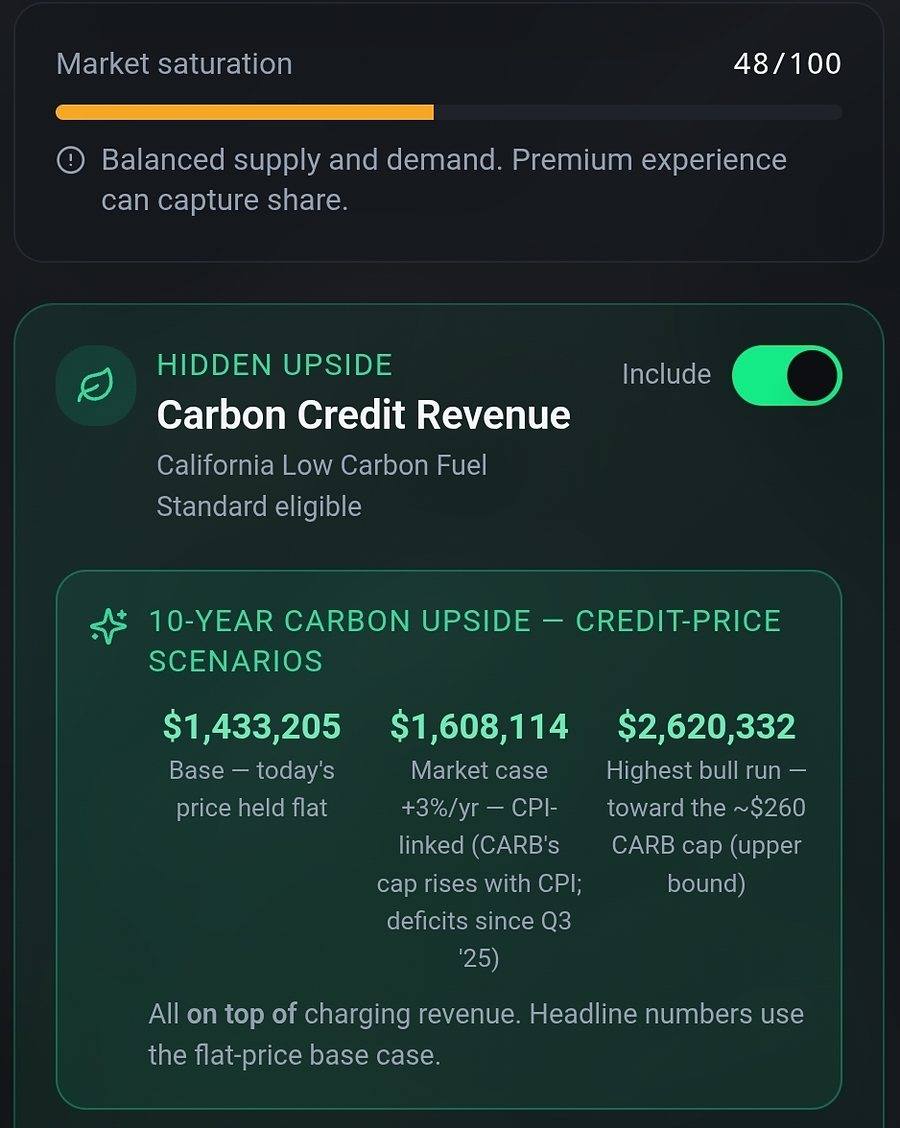
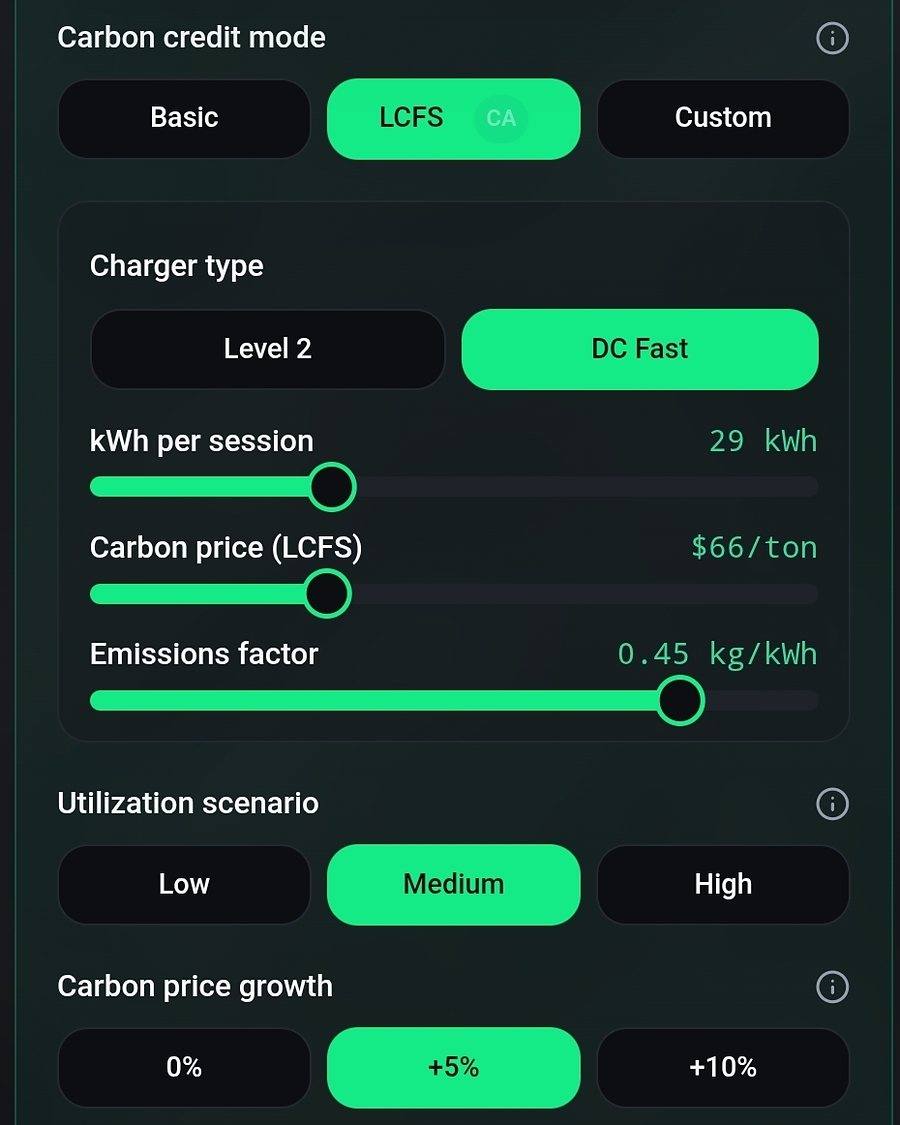
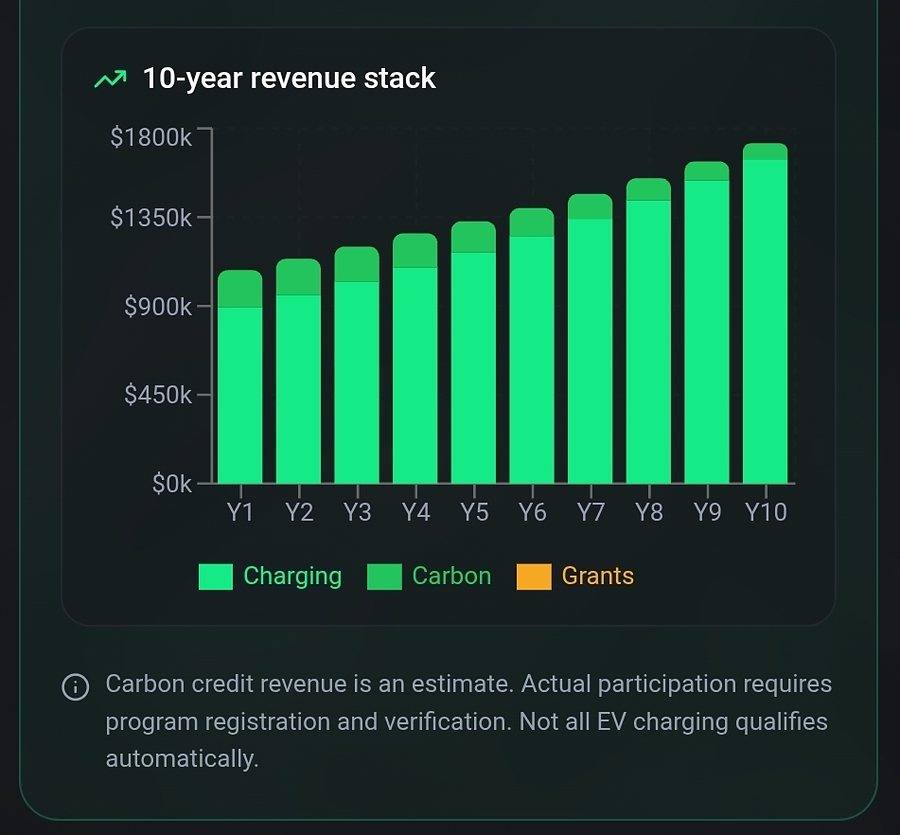
Screens from the Revio site-intelligence platform. Carbon revenue is an estimate: participation requires program registration and verification, and not all EV charging qualifies automatically.
Three ways to engage.
Every engagement is success-based: we are paid from the credits sold and the awards won, so the incentive team's interest is identical to yours.
LCFS & FCI credits
We register, aggregate and monetize your credits.
- Enrollment in the right pathway for your assets
- Metering, verification and quarterly reporting handled
- Volume pooled with other operators for better pricing
- Sold on your behalf — proceeds paid to you
Fee structure — revenue share on credits sold
Grants & incentives
We find the funding and write the application.
- Federal, state, utility and air-district catalog
- Eligibility matched to your sites and equipment
- Full application package, written for you
- Deadline tracking and submission management
Fee structure — success fee on awards won
Credits + grants, combined
Credits, grants and rebates run as one program.
- Everything in the Credit Desk and Grant Desk
- Incentives stacked on top of credit revenue
- Single point of contact and combined reporting
- Priority handling end to end
Fee structure — blended success share
The 2026 rules raised the bar. That favors operators who are set up properly.
Intake to payout, nothing filed unchecked.
Intake
Sites, equipment, fuel and energy data. About five minutes to start.
Eligibility & forecast
A ten-year credit forecast built on each program's own published methodology — not a rule of thumb.
Registration
We register you with the agency or registry, set up metering and data collection, and get you generating.
Compliance review
Ready for review, submitted, approved, issued — every filing checked before it moves.
Brokerage & payout
Credits pooled with other operators, sold into the market, proceeds distributed to you.
Open a credit account.
Tell us about the operation. We return an eligibility map and a modeled forecast of credit revenue and grant capital — before you commit to anything.
The incentive team will return your eligibility map and forecast within a few business days.
Questions owners actually ask.
What is the LCFS?
California's Low Carbon Fuel Standard, a carbon-intensity market run by the California Air Resources Board. Fuels cleaner than the annual benchmark — including grid electricity dispensed into vehicles — generate credits that petroleum refiners and importers must buy to cover their deficits. That regulated demand is what gives the credit a market price.
Who receives LCFS credits from a charging site?
The registered owner of the fuel-supply equipment — which is why the ownership model matters. A property hosting another company's chargers has assigned that revenue away in the host agreement. A host-owned site keeps it.
How often do LCFS credits pay out?
Credits are generated from metered dispensed energy and reported quarterly, with verification. Kept on cadence, a charging site produces credit revenue quarter after quarter for the life of the asset. Credits are sold at market prices, which float — nothing here is guaranteed revenue.
What are the metering requirements?
From the 2026 compliance year, only directly metered electricity earns credits — meters accurate to ±5% on a six-year calibration cycle. Metering is a day-one equipment specification, not a retrofit.
Can grants, make-ready programs and credits be combined?
Generally yes — utility make-ready can fund infrastructure, equipment grants can offset hardware, and LCFS credits pay on operation — but each program has eligibility rules, and some combinations are restricted to prevent double-funding the same scope. Sequencing the applications correctly is most of the work.
Is any of this guaranteed?
No. Credit prices float with the market, grant programs have windows and budgets, and rules change. What is structural: the LCFS pays whoever owns the registered equipment, and programs reward projects that apply before they build.