

Megawatt charging and the freight corridor opportunity
Passenger charging is a retail business: diffuse demand, discretionary routes, sites competing on convenience. Heavy-duty charging is nothing like that. Class 8 electric trucks run fixed corridors on fixed duty cycles under regulatory timelines that are already law in California, and they charge at powers that only a handful of parcels on any given corridor can physically support. That scarcity is the opportunity.
1.2 MW changes what a site is
Megawatt-class charging, 1.2 MW to a single vehicle on the Tesla Semi's Megacharger, with the industry's Megawatt Charging System standard scaling alongside, can return meaningful range inside a federally mandated 30-minute rest break. That single fact organizes the entire business case: charging fits inside time the driver must already spend, on corridors the freight must already travel.
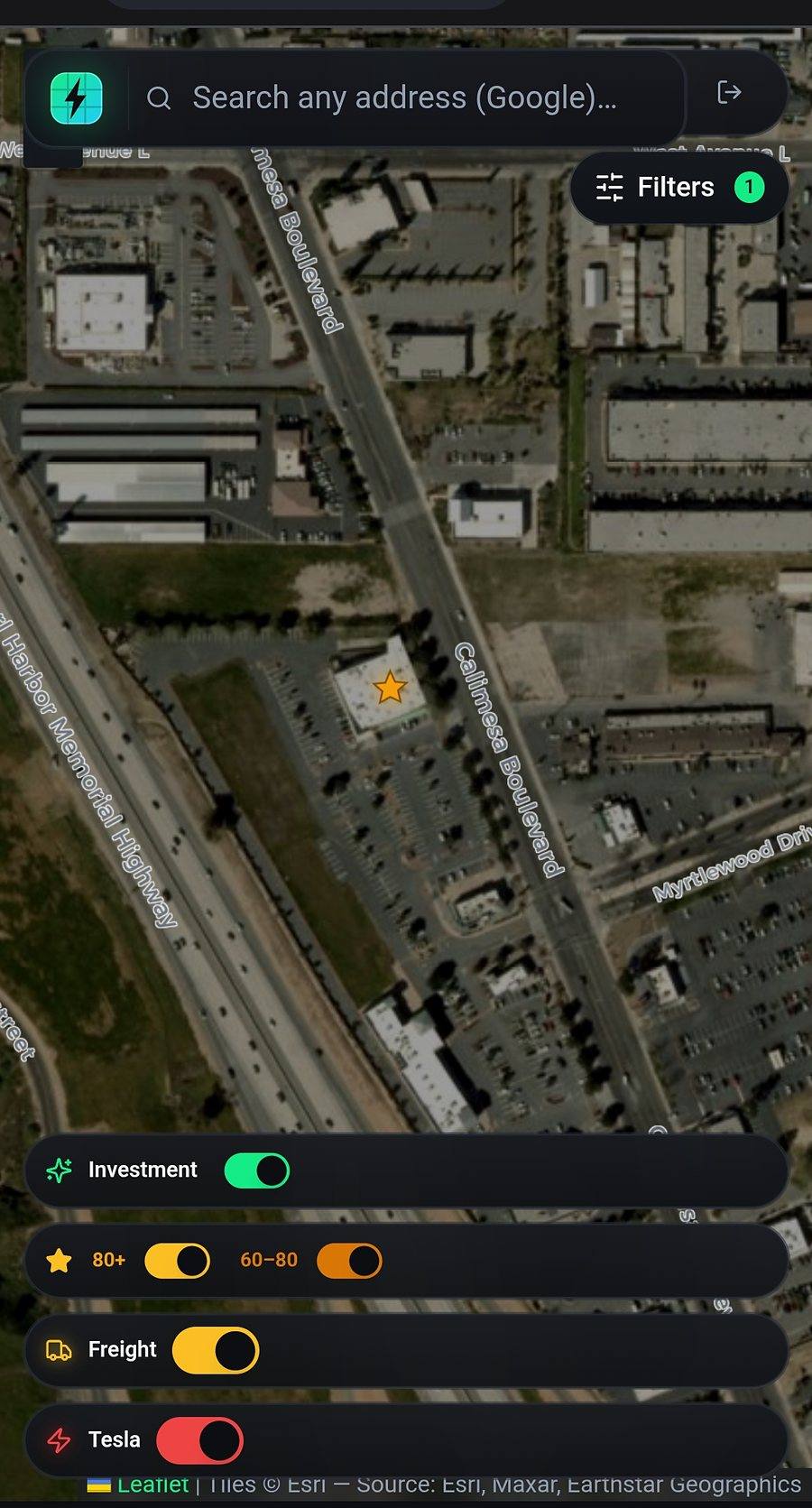
Electrically, a multi-stall megawatt site is utility-scale load, the kind of interconnection conversation that involves circuit studies, dedicated equipment and, on the strongest sites, co-located solar and storage to shave what the grid cannot cheaply deliver at peak. Almost no existing truck stop was built for this. The parcels that combine corridor position, acreage for truck circulation and realistic access to serious utility capacity are countable, and identifying them is a data problem before it is a real-estate problem.
Demand with a regulatory floor
California's Advanced Clean Fleets rules phase zero-emission trucks into drayage and fleet operations on statutory timelines, and the drayage loops serving the ports of Los Angeles, Long Beach and Oakland concentrate that mandated demand onto a short list of corridors. Layer the incentive architecture on top, heavy-duty infrastructure programs at the state level, utility make-ready with medium- and heavy-duty tracks, LCFS credits on every metered kilowatt-hour dispensed to a truck, and freight charging carries something passenger charging never had: demand and subsidy both written into regulation.
The staged build is the sane build
A freight site does not open at full power. It opens with the service, the yard geometry and the electrical spine engineered for megawatt operation, and energizes in stages: high-power DC stalls serving early fleet adopters and medium-duty traffic first, Megacharger-class stalls as corridor volume matures. The discipline is the same one that governs every site we underwrite, scaled up: design the end state, energize in tranches, and let each tranche's revenue, energy, credits, contracted fleet throughput, carry the next.
For the owners of the right parcels, travel plazas, industrial yards, logistics-adjacent retail on the loops, the question is timing. Corridor positions are being taken now, quietly, by operators reading the same maps.
Find out if your parcel is on the map
Corridor position, acreage, utility capacity, the screen tells you in one pass whether your site is a candidate for freight-class charging.
Run a Site Scan