

Multifamily right-to-charge and the landlord's position
California law already gives most tenants a path to install their own EV charger and requires the landlord not to unreasonably stand in the way. Other states have moved in the same direction. For multifamily owners the practical question was never whether charging was coming to the property, it was whether the owner would design it, or simply be asked to approve it, unit by unit, on someone else's terms.
What the law actually forces
Right-to-charge statutes are narrower than they sound. They do not obligate a landlord to build anything. They obligate a landlord to permit a qualifying tenant's own charging installation, typically at the tenant's expense, subject to reasonable conditions on placement, contractor licensing, insurance and code compliance. The landlord can require the work be done properly. What the landlord generally cannot do is refuse outright.
Read that carefully and the incentive flips. A property that does nothing is not avoiding EV charging, it is guaranteeing that charging arrives piecemeal, through a process the owner does not control: a different electrician for every request, a parking assignment negotiated tenant by tenant, panel capacity consumed in whatever order requests happen to arrive. None of that revenue, none of that infrastructure, and none of the discipline that comes from planning a system belongs to the property. It belongs to whichever unit asked first.
The case for getting there first
A property that installs shared Level 2 charging ahead of individual requests changes the transaction entirely. Instead of approving a stream of one-off tenant installs, the owner offers charging as a managed amenity: metered, priced, and built to a service capacity the property actually planned for. A few consequences follow directly:
- Panel capacity gets allocated once, correctly. A managed circuit serving a bank of Level 2 stalls uses shared load management to serve more vehicles on less service than the same number of independent tenant circuits ever could.
- The revenue and the asset stay with the property. A host-owned installation collects the session revenue and depreciates on the owner's books. A tenant-owned charger the owner merely approved does neither, and typically leaves with the tenant, or as a fixture dispute, when the lease ends.
- Leasing gets a genuine amenity line. Guaranteed, reservable charging shows in the listing and the tour, not just in a policy document a prospective tenant has to ask for.
- Parking policy stays the owner's to write. Space assignment, idle-time rules and priority access are set once, in the lease, instead of negotiated ad hoc every time a new request lands on the property manager's desk.
Sizing it as Level 2, not DC fast
Multifamily charging is a different design problem than a public fast-charging site, and it is a friendlier one. Vehicles at a residence dwell for hours, not minutes, so Level 2, roughly 7 to 19 kW per stall, fully replenishes a typical commute's worth of range overnight. That lower per-stall draw is what makes shared circuits and load management effective: a modest service increase, staged correctly, can serve a meaningful share of a parking structure without the industrial-scale interconnection work a DC fast site requires.
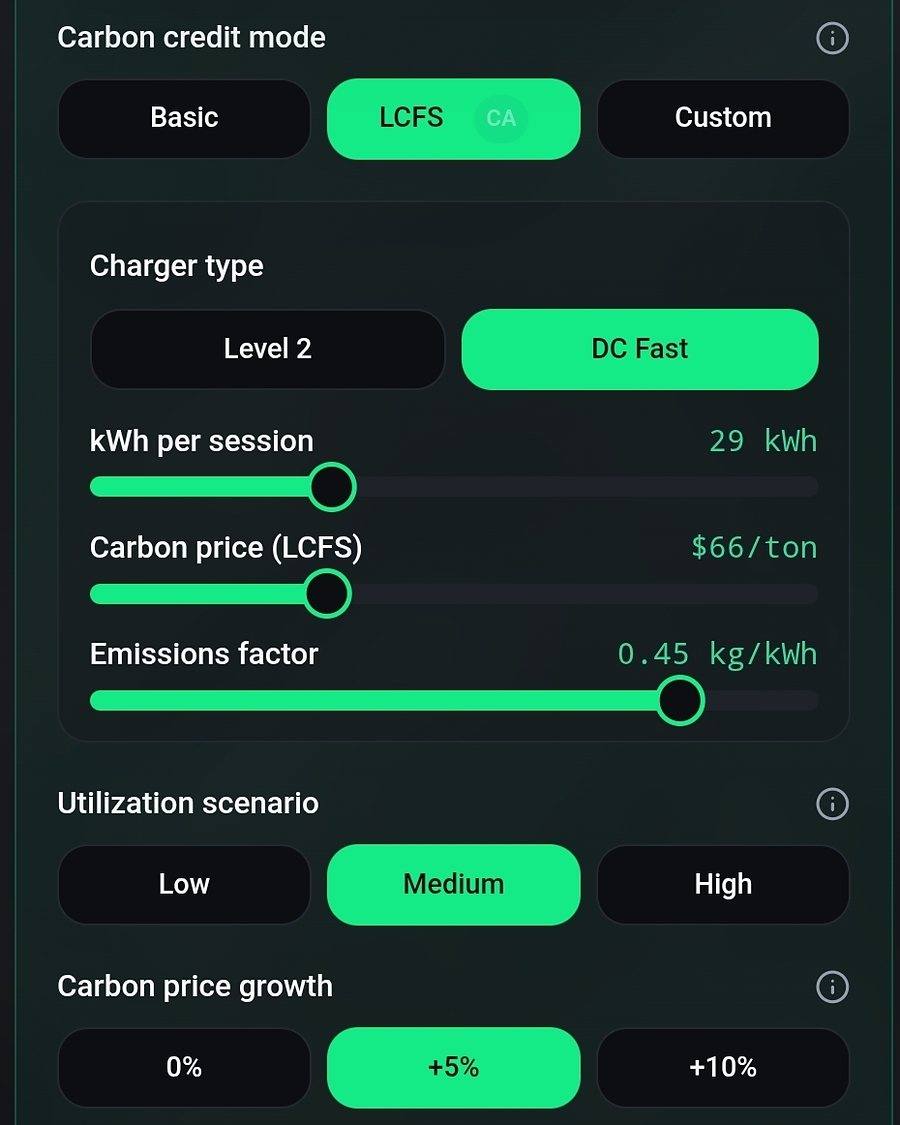
The credit and incentive stack differs by charger class too, which is worth running before committing to a build-out rather than after. A calculator that separates Level 2 from DC fast at the input stage, kilowatt-hours per session, utilization scenario, applicable credit program, gives an owner a defensible range instead of a guess borrowed from a DC fast pro forma that does not describe a residential load profile at all.
What ownership still requires
Host-owned multifamily charging is not a fixture purchase; it is a small operating business layered onto the property. Metering has to allocate cost per unit or per session, not fold into common-area utilities where it quietly subsidizes non-EV residents. Maintenance and driver support are worth contracting out rather than routing through the leasing office. And the lease itself needs charging language, access, priority, idle fees, written before the first stall goes in, not drafted in response to the first dispute over who left an EV parked and unplugged in a charging space overnight.
None of this is harder than what right-to-charge compliance already demands of a property that waits. It is the same work, done once, on the owner's terms, with the asset and the revenue staying where the capital was spent.
Scan the property before the first request lands
Enter an address and our site-intelligence layer returns the preliminary screen, parcel, utility territory, credit eligibility and imagery, in seconds. The full underwriting follows from our team.
Run a Site Scan