

Buying power: PPAs and tariff selection for charging loads
Open a commercial electric account for a new site and the utility assigns a rate schedule based on customer class and service size, the same way it would for a warehouse or a restaurant. Nothing about that default schedule was built for a load that looks like a grocery store all day and a substation for twenty minutes at a time. Under a network lease, that mismatch is someone else's problem. Under host ownership, it sits on the account with the host's name on it, and fixing it is a decision only the account holder can make.
The tariff you are on by default is a guess
A utility's standard commercial tariff was not written with fast charging in mind, it was written for the ordinary spread of small and mid-size commercial accounts a service territory actually has, most of which draw power in a flat, predictable band. A charging site's load shape, near zero most hours, a sharp spike for the length of a session, does not resemble that band, and a default tariff prices the spike the same way it would price a factory running a shift. That is a real cost, and it is not a cost the utility is obligated to flag, the application simply defaults you onto whatever schedule matches your service size unless you ask for something else.
Electing a different tariff is a decision, not a default
Several investor-owned utilities now publish commercial tariffs built specifically for EV charging, most commonly structured as a subscription: the host buys a block of capacity in advance at a predictable monthly price, rather than being billed after the fact for whatever the site's worst fifteen minutes happened to produce. Electing onto one of these schedules is not automatic, it is an application a host has to file, usually with load data or an engineering estimate to support the block size requested, and getting the block size wrong in either direction persists for the life of the account, too small and the site pays overage every month it runs busy, too large and it is subsidizing capacity it never uses.
What a power purchase agreement actually buys
Tariff selection governs how a site is billed for capacity and delivery. It says nothing about the price of the energy itself, which in most territories still floats with wholesale market conditions the utility passes through. A power purchase agreement is a separate, contractual answer to that second question: a multi-year commitment to a set energy price, or a hedge against one, arranged directly with a generator or a marketer rather than left to whatever the default supply rate happens to be that quarter. Where retail choice exists, whether through a deregulated market or a community-choice aggregator standing in for the incumbent utility, a host can also choose the supplier outright, separate from the wires-and-meter relationship, which stays with the utility either way. None of this is exotic; it is the same instrument large industrial and data-center loads have used for years to take energy-price volatility out of a project's underwriting. A charging site is simply a smaller, spikier version of the same problem.
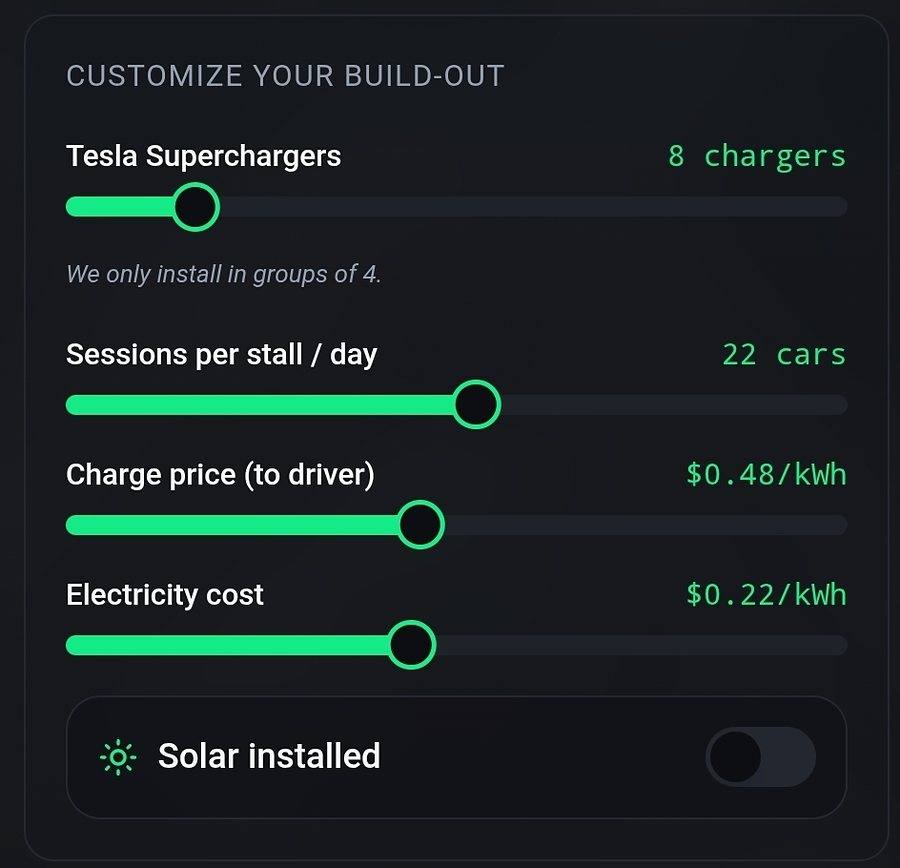
The decision only an owner can make
A network operating under a ground lease has no standing to file a tariff election on someone else's utility account, and no reason to negotiate a supply contract for power it is not the one paying for. That decision sits with whoever holds the meter, which is the definition of the host-owned model: the site's operating economics are not inherited from a lease, they are assembled, line by line, by the party who actually owns them. Tariff and supply are two of the fewest-touched, longest-lived lines in that assembly, set once at commissioning and rarely revisited, which is exactly why getting them right before the meter goes live is worth the extra weeks it takes.
Neither decision requires guessing. Tariff selection follows from the site's own modelled load shape, not a generic EV-charging curve borrowed from another parcel, and a supply contract is only worth signing against a term long enough to matter and a price the site's own economics can absorb if wholesale power moves against it. Both are underwriting questions, answered before the electrical design is frozen rather than discovered on the first bill.
Model the load your site would actually put on the meter
Enter an address and our site-intelligence layer returns the preliminary screen, parcel, utility territory and unit economics, a starting point for the tariff and supply conversation our team runs next.
Run a Site Scan