

LCFS: the revenue line most hosts never collect
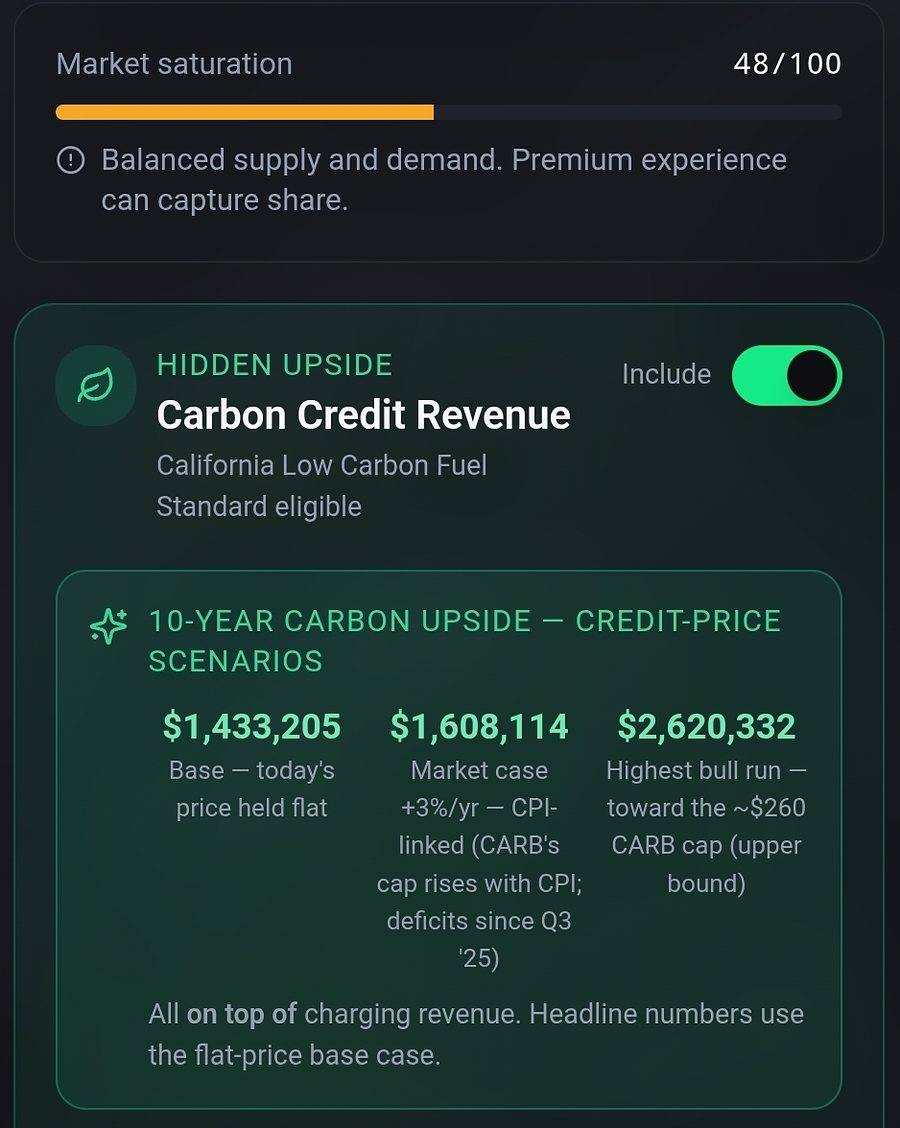
Every kilowatt-hour a public charger dispenses in California displaces petroleum fuel, and the state's Low Carbon Fuel Standard pays for that displacement, in credits with a public market price, generated quarter after quarter for the life of the asset. The mechanics are unglamorous. The consequence is not: on a busy DC fast site, credit revenue can stand alongside the charging margin itself.
How the credit is actually earned
The LCFS is a carbon-intensity market administered by the California Air Resources Board. Fuels dirtier than the annual benchmark generate deficits; fuels cleaner than it, grid electricity very much included, generate credits. Petroleum refiners and importers must retire credits to cover their deficits, which is what gives the credit its price and the market its permanence: demand is written into regulation, not sentiment.
For charging, the credit accrues to the registered fuel-supply equipment owner, computed from metered dispensed energy. Three operational details decide whether that revenue is real:
- Registration. The site and its equipment must be registered with CARB under the correct pathway before credits accrue, there is no retroactive harvest of kilowatt-hours dispensed while unregistered.
- Metering. From the 2026 compliance year, only directly metered electricity earns credits, meters accurate to ±5% on a six-year calibration cycle. Metering is a day-one specification, not an afterthought.
- Reporting. Quarterly, ongoing, with verification. Miss the cadence and the credits lapse; keep it and the asset produces a second income statement line indefinitely.
Fast charging carries its own pathway
California's program includes an infrastructure pathway designed specifically for DC fast charging, which can credit qualifying sites on installed capacity as well as dispensed energy in their early years, a deliberate bridge across the period when utilization is still ramping. Layered with metered credits as volume grows, it reshapes the early cash-flow curve that historically made fast charging hard to finance.
Why this favors the owner
None of this mechanics is secret. What decides who collects is the ownership model: credits follow the registered equipment owner. A property that hosts another company's chargers has, by definition, assigned this line away. A property that owns its stalls, with registration, metering and reporting run competently, keeps a regulated revenue stream that compounds every quarter the site operates.
Credit prices float with the market, program rules evolve, and nothing here is a guarantee of revenue. But the structural point stands still: the LCFS pays the owner. Be the owner.
Model the credit line on your site
Our in-house incentive team registers the assets, meters the energy, files the quarters and monetizes the credits, for the life of the asset. Start with the calculator.
Open the LCFS Calculator