

LCFS: what changes when the credit price moves
A host-owned DC fast site earns its Low Carbon Fuel Standard credits the same way every quarter: metered kilowatt-hours, verified, reported, converted into credits at a rate set by the fuel's carbon intensity. What is not the same every quarter is what those credits are worth. The LCFS credit is a traded commodity with a public market price, and that price moves for reasons that have nothing to do with how well your site is run.
A traded price, not a tariff
It helps to be precise about what the credit actually is. The California Air Resources Board sets the carbon-intensity benchmark that fuels are measured against, and it sets the formula that turns a gap below that benchmark into credits. It does not set the price a credit sells for. That price is negotiated bilaterally between parties who generate credits, electricity among them, and the petroleum refiners and importers who generate deficits and must retire credits to cover them. CARB publishes the trade data every quarter; it does not set the number on the trade.
That distinction matters for underwriting. A tariff is a line item you can put in a model and trust for the life of a contract. A market price is a variable, and the only honest way to treat a variable is to understand what pushes it around.
The bank is the mechanism
Two forces set the price, and they pull against each other every year. On one side, the carbon-intensity benchmark ratchets down on a schedule CARB sets in advance, which mechanically raises the deficits generated per gallon of fossil fuel sold, and deficits are what create demand for credits. On the other side, the program lets credits bank indefinitely, with no expiration, and when clean-fuel supply, renewable diesel, biodiesel and metered electricity among the largest sources, grows faster than deficits do, the banked surplus grows too. A large, growing bank is exactly what suppressed credit prices through the low-demand years of this decade: sellers had more supply than buyers needed, and the price reflected it.
CARB's response was to tighten the schedule itself. Amendments adopted in 2025, in effect for the 2026 compliance year onward, steepen the annual reduction targets specifically to draw the existing bank down faster than it would shrink on its own. The program also runs a Credit Clearance Market, a cost-containment mechanism that caps what a deficit holder can be forced to pay in a given year, so the price has a ceiling built into the rules even though it has no equivalent floor. None of this predicts next quarter's number. It does explain why the number has moved as much as it has, and why it is capable of moving again.
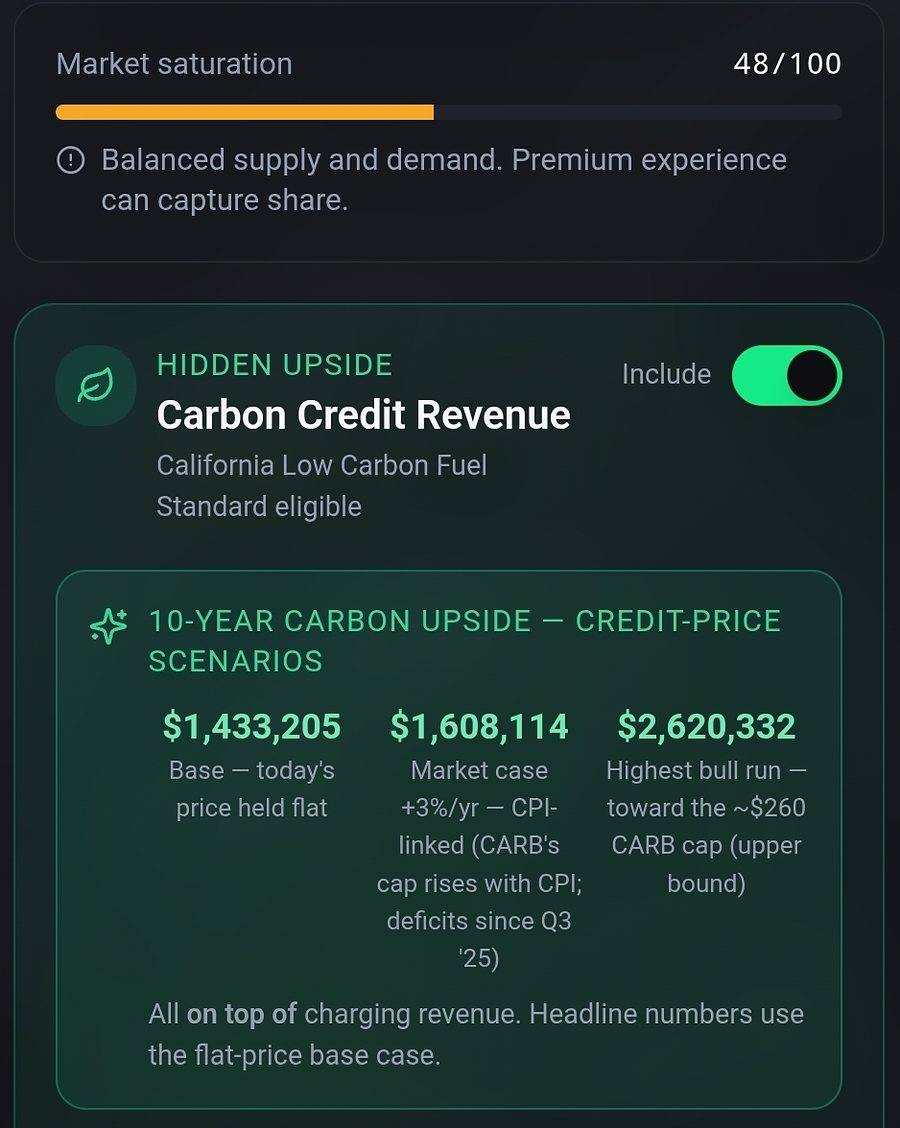
Underwrite a band, not a snapshot
The practical consequence for a site owner is straightforward: do not drop a single credit price into a ten-year pro forma and call the line item done. Model a range, revisit it on the same quarterly cadence the program itself reports on, and separate the two things that are actually certain, the kilowatt-hours your site will dispense and the formula that converts them into credits, from the one thing that is not, what a buyer will pay for the credit that formula produces. A site that is well metered and properly registered captures whatever the market offers in a given quarter. It cannot control what that offer is.
This is also an argument for ownership rather than a detour from the one already made on this blog. A host agreement that assigns the credit away hands off a market exposure along with a market upside; the party holding the registration lives with the price in both directions. Owning the asset means owning that volatility, which is exactly why it has to be modelled as volatility, not promised as income.
Model the credit line on your site
Our in-house incentive team registers the assets, meters the energy and files the quarters, against the current compliance schedule, not last year's. Start with the calculator.
Open the LCFS Calculator