

Siting for traffic you do not have yet
Most site screens answer one question: does this parcel clear the bar today. Current traffic count, current EV registration density, current distance to the nearest fast-charging site. That is the right question for a network deciding where to spend its own capital this quarter. It is the wrong question for a property owner who already controls the parcel, because the owner is not choosing between this site and some other site a network could lease instead. The owner is choosing how much of tomorrow's traffic to build for today, on ground they were going to hold either way.
A snapshot screen and a curve are different instruments
A traffic snapshot tells you what a parcel is worth to lease right now, which is exactly what it is built to do. It says nothing about what the same parcel is worth in year three, after the corridor it sits on has absorbed another few points of EV registration share, after a nearby distribution center finishes its fleet conversion, after the next subdivision down the road opens. None of that shows up in a count taken this month, because the snapshot was never trying to answer a multi-year question. The mistake is using a one-month instrument to make a fifteen-year decision and then being surprised when the parcel that scored marginal on day one is the busiest site in the portfolio by year four.
The inverse mistake is just as common: building full capacity for a curve that never arrives, on a parcel chosen because it looked good on a map rather than because the demand underneath it was actually underwritten. Siting for traffic you do not have yet is not an argument for optimism. It is an argument for sizing the build to a stated growth case instead of to either the snapshot or a guess.
What actually moves the curve
A handful of inputs explain most of the gap between a parcel's traffic today and its traffic in three to five years:
- Registered EV growth in the surrounding market. Registration density already has a trend line behind it, not just a point estimate, and the slope matters more than the current level for a site being sized to last a decade.
- Planned development nearby. Housing, logistics and retail projects already entitled or under construction change a parcel's traffic on a known timeline, well before they show up in any count taken today.
- Fleet and corridor commitments. A distribution center or transit operator that has announced an electrification plan is telling you, directly, when a specific volume of charging demand arrives near a specific road.
- The market-gap trend, not the snapshot. The nearest fast-charging site today may be five miles away; what matters is whether that gap is closing because competitors are watching the same growth case.
Sizing the build to the curve, not the snapshot
The practical answer is almost never all-at-once or not-at-all. It is a build that matches physical commitments to how soon they are needed and leaves the expensive, slow-to-change ones ahead of schedule rather than behind it:
- Service and conduit sized for the end state, installed once. Trenching and electrical service do not get cheaper by waiting, and are the most likely to sit in a utility queue if ordered late. Sizing them for the year-five load while the ground is already open is usually the cheapest capacity a site will ever buy.
- Stall count phased to the curve itself. A site can open with the number of dispensers the current traffic actually supports and add cabinets behind the same service as utilization climbs, rather than carrying idle hardware through the early years or under-building and re-trenching later.
- An outparcel held, not committed. Where land allows it, keeping a second phase pad uncommitted, rather than leasing it away for a use that would block future charging capacity, preserves the option without spending on it before the demand case is proven.
Underwriting the growth case, not just the growth hope
None of this works as a hand-wave, a site is not worth over-building just because someone believes EVs are the future in general. It works when the growth case is specific to the parcel, tied to inputs that can actually be checked, registration trend, entitled development, an announced fleet conversion, a closing market gap, rather than to a national adoption curve that says nothing about this corridor in particular. Surfacing those parcel-level trend inputs alongside the current snapshot turns "we think traffic will grow here" into a stated, revisitable assumption the build can actually be sized against, instead of a feeling that gets forgotten the moment the stalls go in.
The sites that end up right-sized three years out are rarely the ones built to whatever the traffic count said on the day the permit was filed. They are the ones where someone wrote down why the traffic was going to change, built the slow, expensive parts of the site for that number, and left the fast, cheap parts for later.
See the growth case behind your parcel
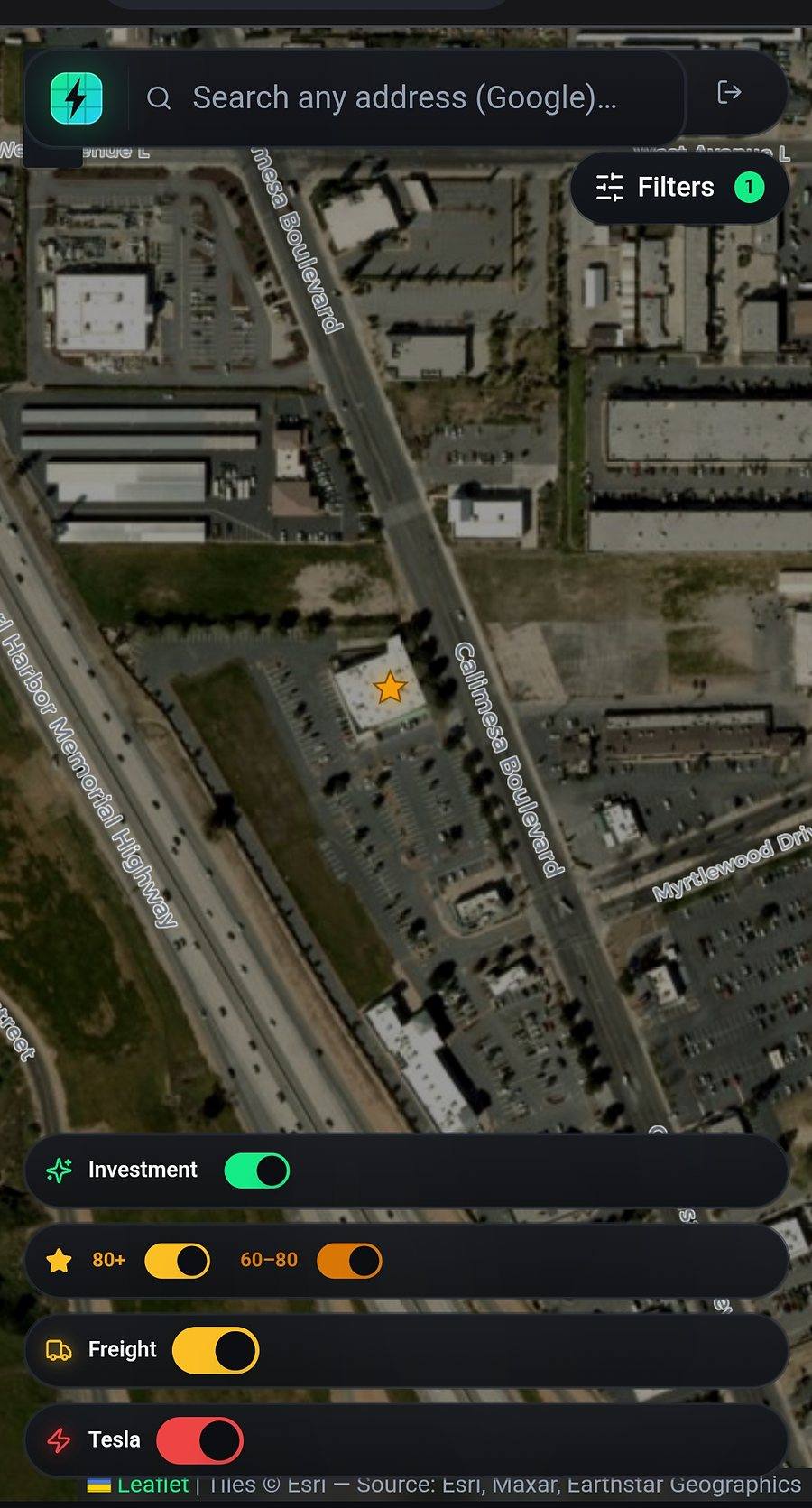
Enter an address and our site-intelligence layer returns the current screen alongside the market and corridor trend context behind it, a starting point for sizing the build to where the traffic is headed, not just where it is today.
Run a Site Scan