

The asset case for host-owned DC fast charging
Most property owners are offered exactly one way into EV charging: a network signs a long lease on your parking stalls, installs its own equipment, and pays you a ground rent. It is a clean deal, and it is the smallest possible share of what the site produces.
Two models, one parcel
A network-operated site and a host-owned site can look identical from the driveway. The difference is where the cash flows land. Under a host agreement, the network owns the chargers, sets the pricing, collects the charging revenue, registers the environmental credits in its own name, and depreciates the asset on its own books. The property receives rent, typically a fixed payment or a thin revenue share, for ten to fifteen years.
Under ownership, every one of those lines belongs to the property. The drivers pay at the stall. The credits accrue to the owner of the dispensing equipment. The depreciation, the incentive stack and the terminal asset value sit with the site. The operating obligations, maintenance, uptime, payment processing, utility bills, are real, and they are contractible: they can be delegated to an operator without surrendering the asset.
Where the revenue actually comes from
A DC fast site earns on three axes at once, and the second is the one host agreements quietly keep:
- Dispensed energy. The retail margin between the price at the stall and the delivered cost of power. Load management and, where the site supports it, on-site storage exist to protect this margin from demand charges.
- Environmental credits. In California, metered public charging generates Low Carbon Fuel Standard credits quarter after quarter, a regulated commodity with a public market price, paid to whoever holds the registration. On a well-utilized fast-charging site this is not a rounding error; it can rival the energy margin itself.
- The property effect. Dwell time, repeat visitation and the tenant-facing amenity value of charging, harder to meter, but landlords in retail and hospitality see it in ticket sizes and occupancy conversations.
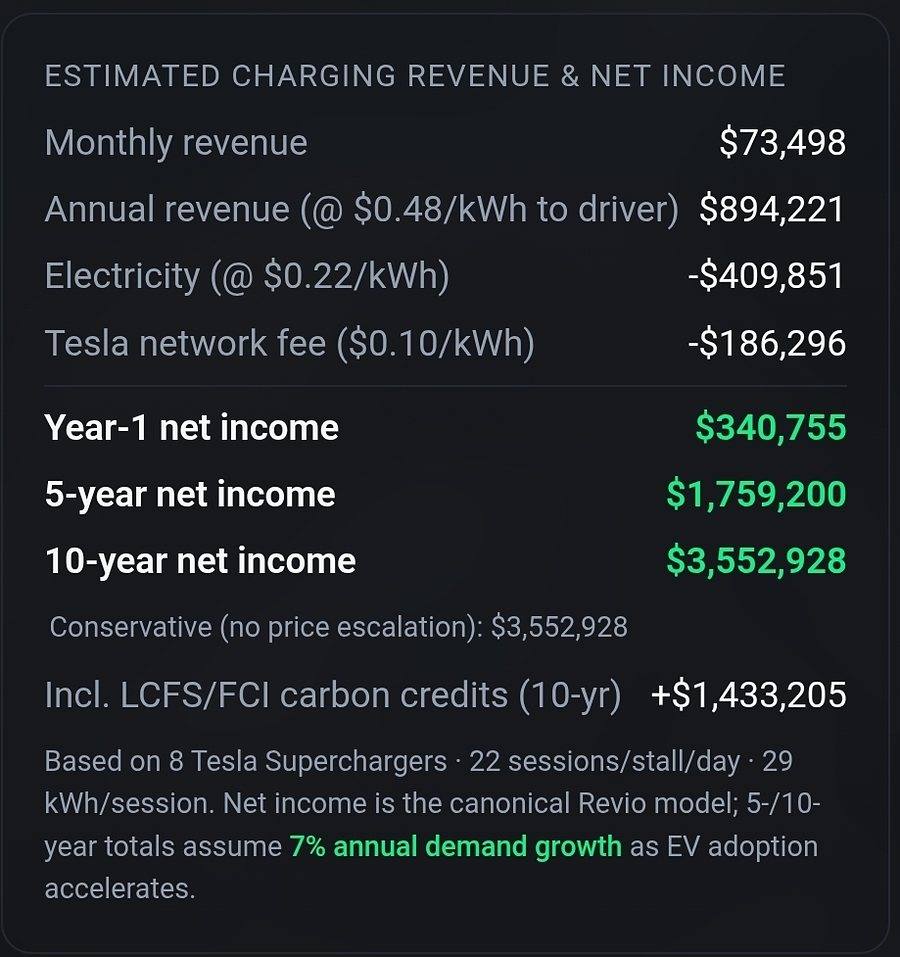
The capital stack is not what it was
The reflex objection to ownership is capital intensity, and five years ago it was decisive. It is far less so now. Federal, state, utility and air-district programs, make-ready allowances that put the utility-side and often the customer-side conduit on the utility's books, equipment grants, and credit-revenue pathways designed specifically for fast charging, can offset a substantial share of installed cost when the applications are engineered into the project from day one rather than bolted on after design.
This is why sequencing matters. A site that pours concrete first and asks about incentives second has usually disqualified itself from the programs that would have paid for the trench.
What ownership obliges you to get right
Host-owned is not a slogan; it is an underwriting discipline. Utilization has to be modelled against real traffic, not hoped for. The utility service has to be sized for the build-out you intend in year five, not the stalls you energize in year one. Metering has to be specified for credit compliance from the first kilowatt-hour. Uptime has to be contracted with penalties, because a public site that reads “out of service” is a liability with your name on it.
None of this is exotic. It is the same rigor any income-producing improvement demands, applied to an asset class that regulation is actively subsidizing into existence.
Run the screen on your parcel
Enter an address and our site-intelligence layer returns the preliminary screen, parcel, utility territory, credit eligibility and imagery, in seconds. The full underwriting follows from our team.
Run a Site Scan