

Demand charges and why storage exists
Most people underwriting a charging site model the cost of electricity the way they model a utility bill at home: kilowatt-hours consumed, multiplied by a rate. On a commercial account serving DC fast chargers, that is the smaller half of the story. The other half is a charge assessed not on how much energy you used but on how hard you pulled at your worst moment, and in the early years of a site's life, it is the line that decides whether the asset performs.
What a demand charge actually measures
Commercial electric tariffs bill two distinct things. Energy is volumetric: kilowatt-hours, priced by time of use. Demand is capacity: the highest average draw recorded over a short interval, typically fifteen minutes, anywhere in the billing period, priced per kilowatt. The utility is charging you for the size of the pipe it had to keep ready for you, not the water you drew through it.
For an office or a grocery store, that peak is a stable, predictable thing: HVAC and refrigeration produce a load shape that repeats. A fast-charging site is the opposite. Two 350 kW cabinets serving four stalls can go from near zero to most of a megawatt in seconds, hold it for twenty minutes, and drop back. Nothing about that peak correlates with how many sessions you sold that month. One truck at the wrong instant on the last day of the month resets the number.
Why this is a utilization problem, not a rate problem
Here is the mechanic that surprises people: a demand charge is a fixed dollar amount for the month, so its cost per kilowatt-hour dispensed falls as throughput rises. The same peak spread across many more sessions is a rounding error; spread across a handful, it can exceed the energy cost several times over. Fast charging's cost structure is therefore inverted relative to intuition, the expensive years are the empty ones, and the site gets cheaper to run per unit sold precisely as it gets busier.
That is the real reason the year-two inflection shows up in charging pro formas, and the reason a site sized honestly to its traffic outperforms one sized to ambition. It is also why regulators have taken an interest.
Three legitimate responses
Operators have exactly three levers, and mature sites use all of them:
- Tariff selection. California's investor-owned utilities offer commercial EV-specific rate schedules that replace conventional demand charges with subscription-style capacity blocks, you buy the capacity you need in increments and pay a predictable monthly amount for it. Choosing the wrong schedule, or the right one at the wrong block size, is a self-inflicted expense that persists for the life of the account.
- Power management. Modern charging systems can share a fixed power envelope across stalls dynamically, tapering an in-progress session rather than letting a simultaneous arrival breach the site's ceiling. Configured well, it costs drivers minutes and saves the site a tier of billed capacity. Configured badly, it makes the site feel slow.
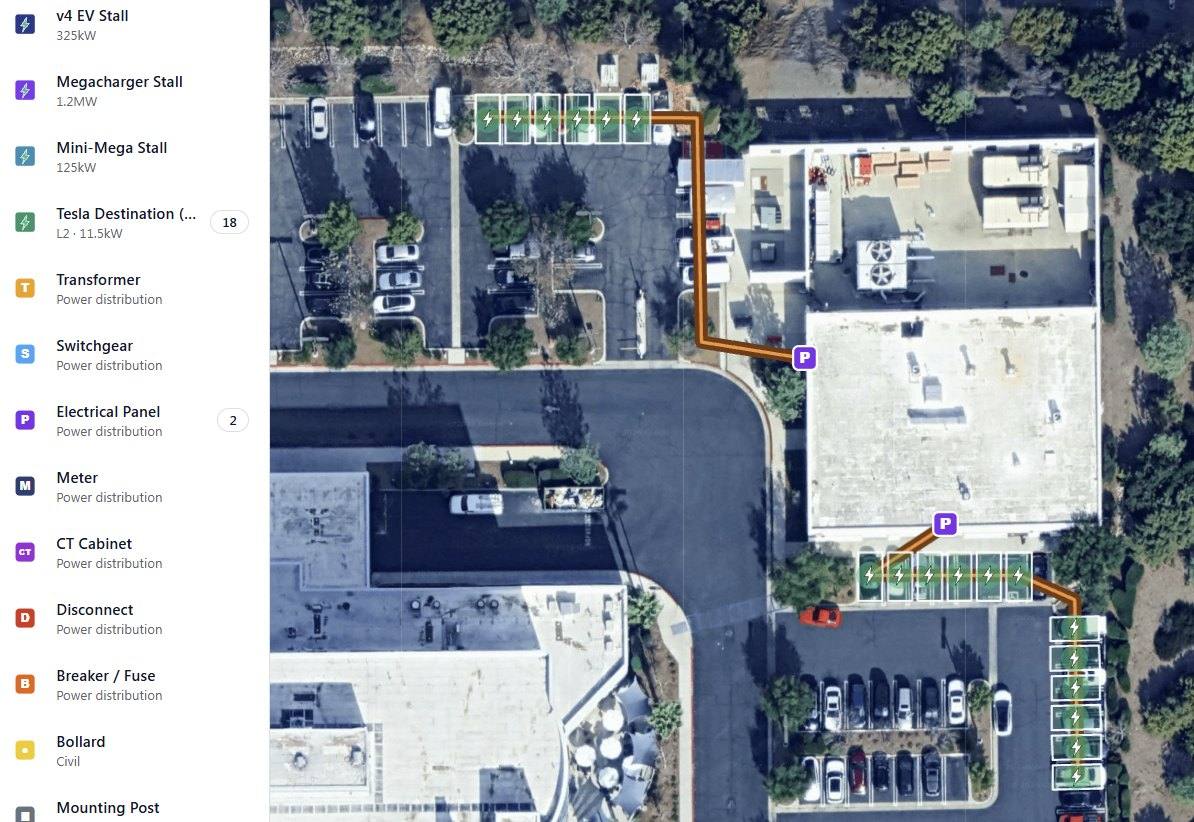
- Storage. A battery sited behind the meter charges during cheap, low-demand hours and discharges into the stalls during simultaneous sessions, so the utility sees a flattened load that never reveals the true instantaneous draw. This is the whole reason batteries keep appearing beside charging cabinets, not resilience marketing, but arbitrage against a capacity charge.
Storage is not automatically the answer
A battery is capital, footprint, permitting scope, a thermal and fire-code conversation, and a degrading asset with its own maintenance profile. It earns its place when the demand exposure it removes exceeds what it costs to own, a calculation that depends on the tariff you land on, the peaks your traffic actually produces, and whether incentive programs cover part of the hardware. On a subscription rate at a site with modest simultaneity, storage can be a solution to a problem you already priced away. On a high-simultaneity corridor site under a conventional demand tariff, it can be the difference between a good asset and a poor one.
The point is not that every site needs a battery. It is that the demand question has to be answered before the concrete is poured, because tariff, stall count, cabinet sizing, transformer capacity and storage are one interlocking decision, and only the owner of the asset is in a position to make it in their own favor.
Model your site's real electrical cost
Our fixed-scope quotes include tariff analysis, load modelling and a storage recommendation, before the design is frozen, while it is still cheap to change.
Request a Charging Quote