

Pricing a kWh at the stall
Under a network lease, the price on the screen is someone else's decision, updated on someone else's schedule, defending someone else's margin. Under host ownership, it is the single lever that determines whether a well-built site earns back its capital in five years or nine. Most owners have never had to set it, because most owners have never owned the equipment that made the decision theirs.
Per-kWh is not optional anymore
For years, public charging was commonly billed by the minute, because the metering needed to bill by the kilowatt-hour was not certified for retail sale in most jurisdictions. That gap has been closing state by state, as weights-and-measures regulators bring EV dispensers under the same certification regime as a gas pump. Where per-kWh billing is required, the price a driver sees has to equal the price a regulator can audit, which means the pricing decision a host actually controls is not the sticker rate but everything that sits behind it: time-of-use structure, membership tiers, idle fees and the blended margin the rate is built to protect.
This matters for site design as much as for accounting. A dispenser that cannot meter and bill per kWh in a state that requires it is not a pricing problem to solve later, it is a permitting problem to solve before the concrete is poured.
The margin is the spread, not the sticker price
The number on the screen is retail. What it has to clear is a stack of costs that network operators absorb quietly and hosts have to underwrite explicitly:
- Delivered cost of power. The utility rate at the meter, which for a DC fast site is rarely a flat per-kWh number, it is energy plus a demand charge keyed to the site's peak draw in the billing period, and the demand charge is the line that punishes a site priced to move volume without a plan for coincident peaks.
- Network and payment fees. Card processing, network software, driver-app integration, real costs whether the host runs its own network software or licenses someone else's, and easy to under-budget because they scale with transaction count, not with revenue.
- Credit revenue, priced in reverse. Where environmental credits accrue to the site, they can support a lower sticker price than the raw energy economics alone would justify, a host who prices to energy costs alone is leaving a lever unused, not being conservative.
Time-of-use pricing is a demand-charge tool wearing a customer-experience hat
Charging more per kWh in the afternoon and less overnight looks, from the driver's seat, like ordinary dynamic pricing. From the host's seat it is a direct lever on the demand charge: session volume that shifts even modestly away from a site's existing peak reduces the kW figure the utility bills against for the entire month. On-site storage does the same job by shaving the peak directly rather than asking drivers to reschedule around it. Most sites eventually run some blend of both, storage where the capital and the utilization justify it, time-of-use pricing everywhere, because it costs nothing to configure and directly targets the line item most likely to erase a thin margin.
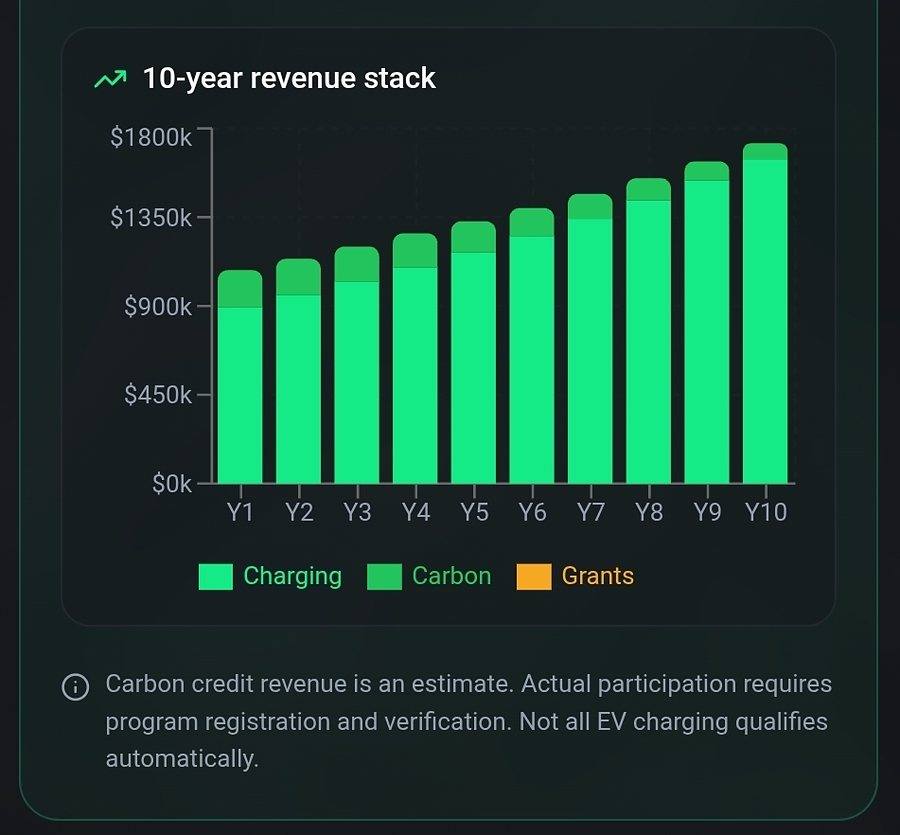
Where the price actually gets set
In practice, pricing a stall is a small number of decisions made once and revisited quarterly, not a live market. A host sets a base per-kWh rate calibrated to the delivered cost of power plus a target margin; layers in a time-of-use spread sized to the site's own peak, not a generic curve borrowed from elsewhere; decides whether a membership or fleet tier earns a discount in exchange for predictable off-peak volume; and sets an idle fee that protects turnover at a site with real dwell competition for the stall. None of this requires guessing at driver price sensitivity site by site, it requires knowing the site's own cost stack well enough that the rate is built on it rather than copied from a competitor's screen.
That is the underwriting discipline ownership imposes, and it is also the reason the decision is worth having. A network sets its price to clear its own hurdle rate across a portfolio of leased parcels. A host sets it to clear the economics of one site the host actually understands, which, run correctly, is a lower bar to clear and a wider margin to keep.
Model the pricing your site would need
Enter an address and our site-intelligence layer returns the preliminary screen, parcel, utility territory, credit eligibility and imagery, as a starting point for the underwriting. The full pricing model follows from our team.
Run a Site Scan