

Quarterly credit generation as an operating line
Charging revenue arrives the way a utility bill does: continuously, priced per session, reconciled whenever the host wants to look. The Low Carbon Fuel Standard credit a host-owned site also earns on every one of those kilowatt-hours does not behave the same way. It is generated, verified and made sellable on California Air Resources Board's quarterly reporting cycle, and a finance team that models it as a smooth monthly accrual will be wrong about when the cash actually shows up.
Two different clocks
A charging session settles in something close to real time: the driver pays, the network or the point-of-sale system records it, and the revenue lands on whatever schedule the payment processor runs. LCFS credit generation runs on a separate, slower clock entirely. Metered dispensed electricity for a given quarter has to be aggregated, attributed to the correct fuel pathway and submitted in a quarterly report to CARB. That report is not generating credits the moment it is filed, either — it is reviewed, and the credits it describes post to the generator's account only once that review clears. A site can be dispensing clean, metered, perfectly creditable electricity all quarter long and have nothing to show for it, on paper, until well after the quarter has closed.
That gap is not a flaw in the program. It exists because the credit is a regulatory instrument, not an invoice, and regulatory instruments get verified before they get valued. The practical point for a host is simpler: the energy that earns the credit and the credit that can actually be sold are separated by a reporting cycle and a review, not a few days of processing float.
Why a monthly accrual misreads the line
It is tempting, in a pro forma, to take an annual LCFS estimate and divide it by twelve so it sits next to charging revenue as a tidy monthly figure. That treatment understates the truth of the asset. Credit generation is lumpy by design: it steps up once per quarter, in a batch, after a filing and a review, not in twelve equal installments. A host that plans working capital against a smoothed number can find itself short in the months between filings and sitting on an unsold credit balance right after one, with no operational change at the charger to explain either.
The fix is not more precision in the estimate. It is matching the model's cadence to the program's. Forecast LCFS revenue in quarters, tied to the same filing calendar CARB itself runs on, and treat the credits that post after each review as a batch decision — hold them against a view on where the market price is headed, or sell into the quarter's demand — rather than a number that trickles in behind the scenes. A site with disciplined metering and registration controls the first half of that timeline completely. It controls the second half, the hold-or-sell call, just as directly, and that call only gets made well if it is made on purpose, on a schedule, instead of by default whenever someone happens to check the account.
What this changes about underwriting
None of this changes what the credit is ultimately worth over the life of the asset — that question is about the market price, and it has its own answer. This is a question about timing, and timing is its own underwriting risk. A site financed against an assumption that LCFS cash lands monthly, evenly, starting in month one, is financed against a shape of cash flow the program was never built to produce. A site financed against the program's actual cadence — a lag before the first filing, a step-function after every review, nothing in between — is financed against the asset that actually exists.
This is also where owning the registration pays off in a way that is easy to undervalue. A host that has assigned its LCFS registration away has handed off this timing problem along with the credit itself; whoever holds the registration is the one living with the quarterly rhythm and making the hold-or-sell call. A host that keeps the registration keeps the decision, which only matters if the decision is actually made on the cadence the program runs on, not whenever the credit happens to get noticed.
Model the credit line on your site
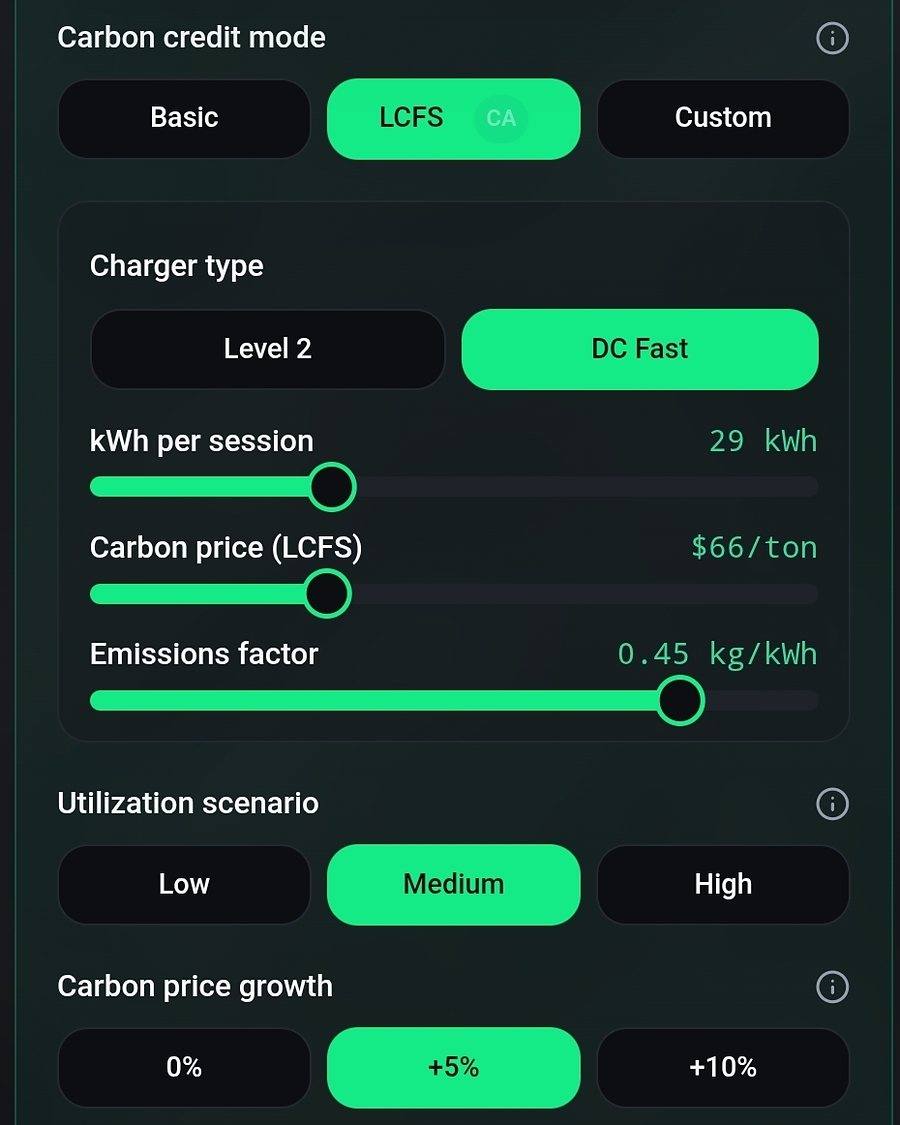
Our in-house incentive team registers the assets, meters the energy and files the quarters, on CARB's own calendar, not a smoothed approximation of it. Start with the calculator.
Open the LCFS Calculator