

Stacking CALeVIP and make-ready without double-dipping
Most hosts hear about California's charging incentives as a single pool of money to apply to once. In practice it is at least two separate programs, run by two separate institutions, funding two separate things — and the question that trips up a site's paperwork is not whether both can be used, but whether the same dollar of cost has been claimed twice.
Two programs, two different things
The California Electric Vehicle Infrastructure Project — CALeVIP — is a state-funded rebate program, administered regionally on behalf of the California Energy Commission, that reimburses a share of the cost to purchase and install charging equipment. It runs in funding rounds tied to specific regions, with rebate caps that vary by connector type, power level and whether the site sits in a priority community. It is a grant against a project cost.
A utility make-ready program is a different instrument entirely. Each investor-owned utility — PG&E, Southern California Edison, San Diego Gas & Electric — runs its own version, and instead of a rebate check, the utility pays for (and in many cases owns and maintains) the grid-side infrastructure needed to bring adequate service to the parcel: the transformer, the conduit run, sometimes the panel work up to the charger itself. That cost is recovered through the utility's rate base, not a legislative appropriation, which is why the rules governing it look nothing like a state grant's.
Where the double-dip actually happens
Every CALeVIP and make-ready application asks the same underlying question in different words: what other funding is this project receiving, and for which line items? The overlap risk sits in the categories both programs can technically touch — trenching, conduit and panel upgrades most commonly — where a site that has already had that work funded under a utility's make-ready program cannot turn around and submit the identical invoice line to CALeVIP. Reviewers cross-check for exactly this, and a rebate built on a cost item already covered elsewhere gets reduced or rejected, sometimes after the equipment is already in the ground.
The safer read is that the two programs are additive across categories, not across dollars: make-ready funds the grid-side path to the parcel, and the rebate funds what is left of the equipment and site cost once that grid-side scope is defined and excluded.
The sequencing that avoids the problem
Because a utility's make-ready scope is decided first — it depends on the service size the utility agrees to bring to the site — engaging that program before finalizing a CALeVIP application is not just good order, it is what makes the rebate application accurate. A project that applies to a rebate program against a full, undifferentiated cost estimate, then separately negotiates make-ready after the fact, is the one that ends up re-filing paperwork to remove costs the utility already agreed to cover.
The practical order: confirm the utility's make-ready scope and cost split for the site, then build the CALeVIP application around what remains — equipment, any customer-side work outside the utility's scope, and site costs the make-ready program does not touch. Keep the cost categories documented separately from the start, because that split is exactly what a reviewer on either side will ask to see.
Read the fine print early, not after the concrete pour
CALeVIP funding rounds are regional and finite — a region can close to new applications once its allocation is committed, independent of whether a project is otherwise ready. A site that finalizes its electrical design and begins construction before checking either program's current status has usually already narrowed its own options: the make-ready scope is harder to negotiate once the utility work is underway, and a rebate round that closed during construction is not coming back for that project. The programs reward the sites that ask the sequencing question before the trenching starts, not after.
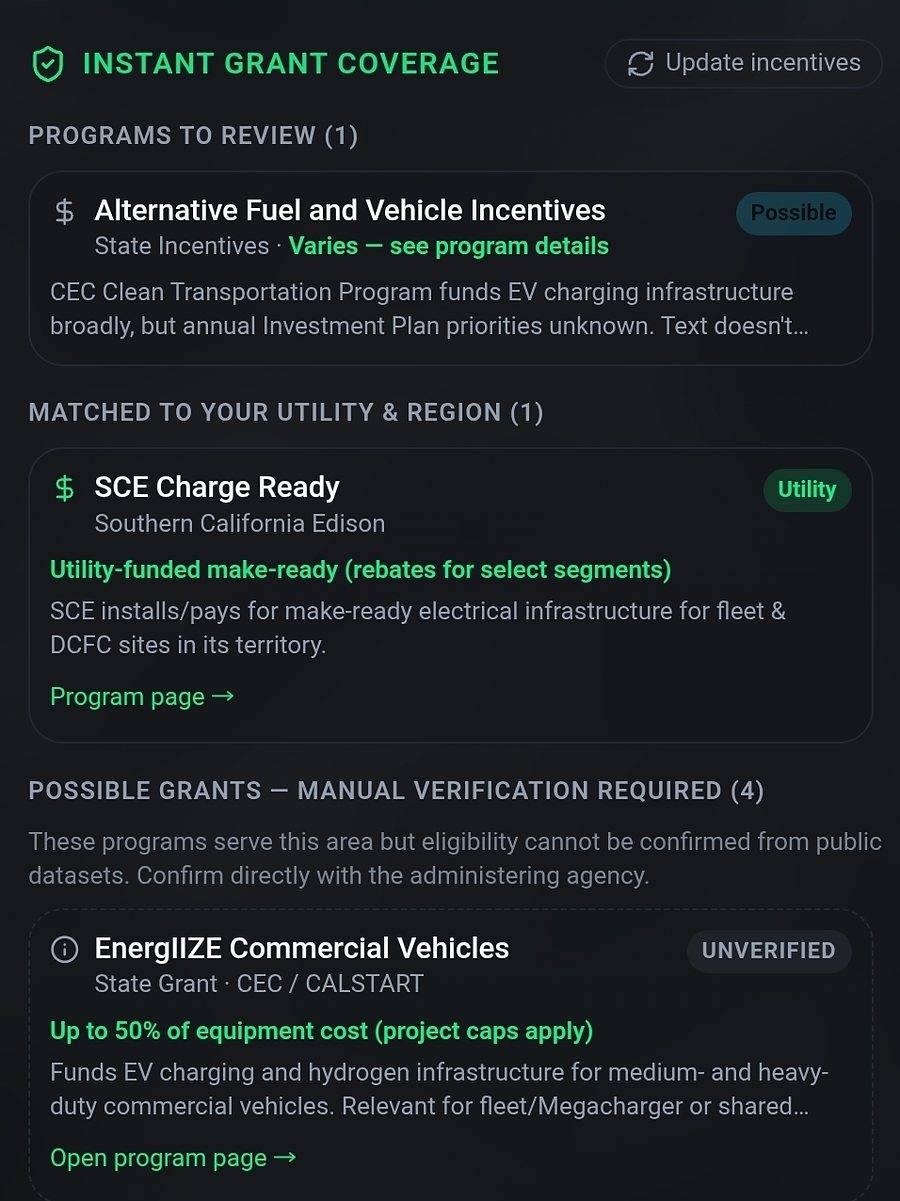
See what your site qualifies for
Our incentive calculator matches a parcel against active state and utility programs, flags what needs manual verification, and shows where make-ready and rebate scopes are likely to split.
Run the Incentive Calculator