

Why networks want your parcel (and what it tells you)
A charging network does not knock on doors at random. By the time a business-development representative calls about your outparcel, a real-estate team has already scored the site against traffic, access, grid proximity and the competitive map, and decided it clears their bar. The call is the last step in a process you were never shown. Understanding that process is worth more than the lease they are about to offer you.
What a site screen actually weighs
Strip away the pitch and every network is running some version of the same model, because the underlying physics and economics do not change by brand. Four categories dominate:
- Access. Visibility from the arterial, ease of turning in and out at speed, and proximity to a highway interchange or a corridor drivers already travel. A parcel set back behind a shopping center, however large, scores worse than a pad site at the light.
- Grid proximity. Distance to an adequate distribution line or substation, and whether the utility's own capacity maps show headroom nearby. A site with the right traffic and the wrong grid position can sit in a queue for years before it ever registers a session.
- Market gap. How far the nearest fast-charging site is, and whether the surrounding EV registration density and daily traffic count can support another one without cannibalizing it. Networks build where drivers already need a stall, not where they hope demand eventually shows up.
- Dwell anchor. A quick-service restaurant, a grocery store or a retail anchor next door converts a twenty-minute charging session into a transaction the tenant mix already wanted. A parcel with nothing to do nearby is a harder sell to drivers, whatever the electrical picture looks like.
The score is portable
None of these four factors belong to the network. Access, grid proximity, market gap and dwell anchor are properties of the parcel, not properties of the lease. A site-intelligence tool can compute the same score a real-estate team runs internally, speed, access, reliability and market compressed into one comparable ranking, before any conversation with a network begins. The output does not change depending on who owns the chargers. What changes is who captures the value the score predicts.
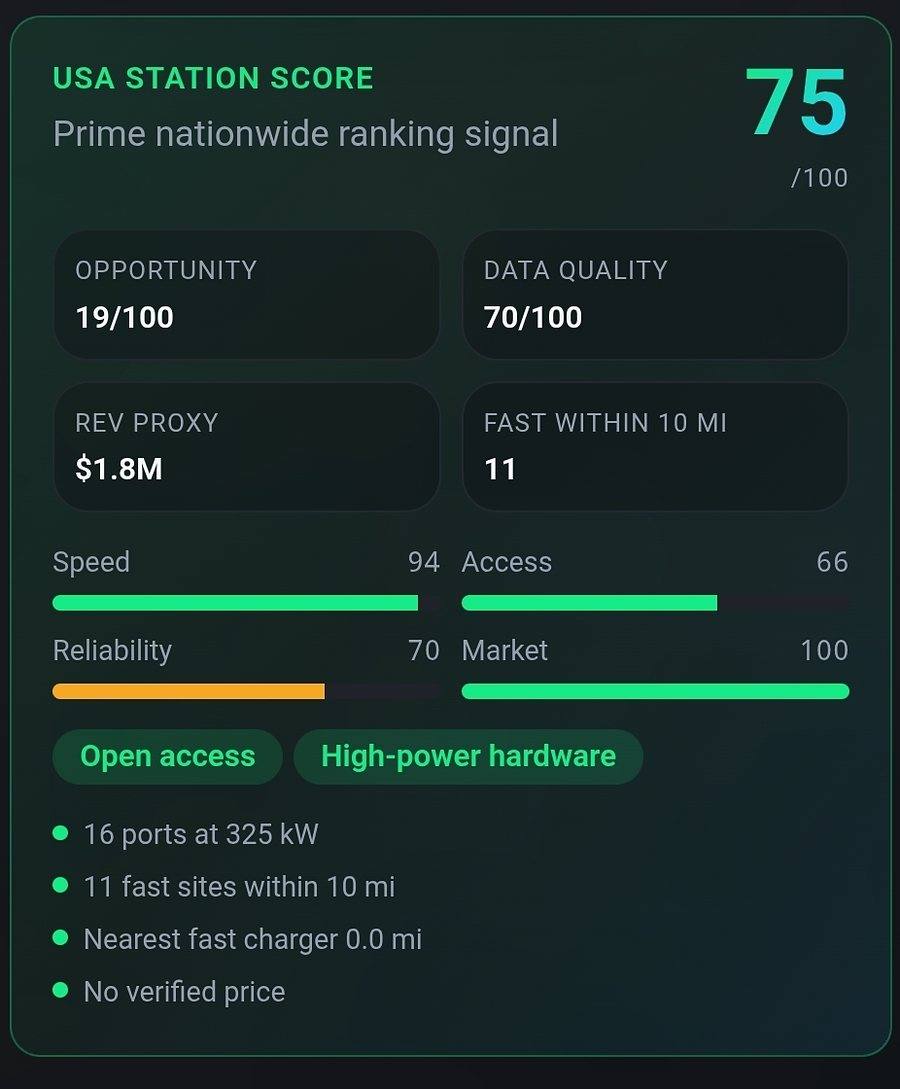
Why the outreach itself is a signal
Unsolicited interest from a network is, in effect, a free site screen delivered by a party with every incentive to undersell what it found. A network's ground-lease offer is priced to clear its own hurdle rate on the charging revenue, the credit revenue and the dwell effect it expects to capture, not to share those numbers with the landowner. The stronger the interest, the more those numbers are likely to favor the site, and the less reason there is to accept the first structure offered without first understanding what the parcel is actually worth as an energized asset.
This does not mean every approached property should self-develop. Ownership carries real underwriting, permitting and operating obligations, and a hosted deal can still be the right call for an owner who wants none of that exposure. It means the decision should follow a screen the owner controls, not a term sheet timed to close before one exists.
Running your own screen first
The sequence that protects a property owner is simple: score the parcel independently, understand roughly where it lands relative to the market gap and grid proximity a network would see, and only then evaluate any inbound offer against what self-development or a joint structure could plausibly return. A parcel that scores well enough to attract a network almost always scores well enough to justify at least modeling the host-owned path before signing away fifteen years of upside for a fixed rent.
See how your parcel scores
Enter an address and our site-intelligence layer returns the same signals a network would use, access, grid proximity, market gap and imagery, before you take a call from anyone else.
Run a Site Scan